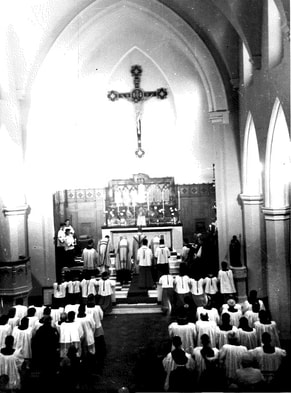
The teaching of the Catholic faith was a very serious business and you needed to be thoroughly taught the fundamentals of the Catacism. That was the handbook of what a sin is and how you should avoid committing any sin at all. At about eight you make your first confession of your transgressions to the priest who was hiding on the other side of the confessional behind a purple curtain. He will give you absolution and a punishment of a decade of the rosary. That’s one Our Father, ten Hail Mary’s and a Glory be to the Father depending on the severity of your sins. When the priest comes out those he has given a whole rosary to for their sins are still there praying for redemption. Now he knows who these naughty ones are. But at seven years old I don’t know what I’ve done that was a sin. Can’t be rude to parents just get a whack, don’t know any swearwords that are worse than what Dad says and what else at seven is there that counts as a sin, it was all very confusing.
When you make it to your first Holy Communion you can only receive if your pure and free from sin. That means you have to make visit to the confessional the day before so that when you get the host it’s going into a sin free body. Some of my friends, who weren’t Catholics related that they didn’t have any of this great singsong, or a fiery sermon threatening hell and damnation. If you did naughty things, while we had confession, ommunion and fiery hell and damnation sermons on Sundays whatever time Mass you went to.About this time a number of us who had grown up together were taught to become altarboys serving the priest saying the Mass which was all in Latin,and we had to learn the whole Mass to respond to the priest on behalf of the congregation,with our backs to them all the way through.
Confirmation really completes the process of being wholly a Catholic and this is done by the Bishop who deals with each child to embrace them into the faith.Bishop’s rarely appear unless something is wrong other than for confirmations or Church dedications.Bishop Grimshaw had been a popular man and when he moved on the new one was a very austere guy called Restioux and most of the congregation disliked him,I know mother couldn’t stand him ” if he thinks I’m going to kiss that ring on his finger he can want on” was mother to Father she definitely wasn’t a fan of this Bishop.
Serving Mass was o k but when we moved to Renown St if anyone didn’t turn up to serve the Mass who was the closest and however early when Mr Duggan came knocking before I could say anything and sometimes I was still in bed and this is the early Mass,mother would say he’ll be there in a minute Mr Duggan,and that’s the end of it.The fact I was down to serve the 11 o clock meant a whole morning in church and a sung high mass at 11, I’m in church all morning.There were some lighter moments I used to get into trouble for,although I always though it was a bit harsh.There were four huge candles on the altar and they were in fact steel tubes painted white and in fact had a spring mechanism with a relatively short actual candle inside.These were lit prior to Mass by a lighted taper on a long pole which also had a snuffer on it as well.I was from time to time known to remove the short candle when no one was around.The result was some poor other altarboy trying hard to light a candle that isn’t there and running out of taper.These candles were a good seven feet above headheight so no indication a candle missing was obvious.
The other trick of mine was to soak the tablet of incense in water for as long as possible before a high sung Mass.Wafting a thurible with a burning insence tablet and the priest adding more powder insence on it stank the whole church out especially at the long high Mass with lots of watching around the altar. Don’t think I ever got caught out but I noticed I was the thurible swinger less often as time went by which I was quite happy about.
The most memorable time was the month of May the celebration of Mary the mother of Jesus.The Church would organise a procession around Renown St and Ocean St carrying a statue of Mary,rose petals would be dropped in front of the procession all the way round and ending in Benediction at the Church.All the children were involved and both streets would be lined on a Sunday afternoon to watch.That has always remained in my mind it obviously made an impact on me.
Author: flutterby
-
Catholic Teachings
-
Voting
I found myself at Keyham Barton Primary receiving a Catholic education to sit some monumental exam at 11 which would shape my future. That was the daily scenario at school.
Outside of school time, I could play and relax with my friends from the school providing I had fulfilled all the religious obligations. There was always an end wall to play football against or on better days a kick-about at North Down Recreation fields. At home was a different story, Mum and Dad were strong members of the Labour Party and they had been swept to government in 1945. Dad was the Agent running the elections in Ford Ward, which Keyham was part of.
There would always be things to do around November and December when the voting registers were issued. These would be cut up into streets and stuck onto strawcards about 12″ X 8″ with paste and and a brush. These were the canvas cards which from about March would be used by canvas teams in the election for Council in May. One councillor would retire to seek re election or retire completely each year. If three councillors from the same party won seats, an Alderman would be appointed from that party and a by election held to replace a councillor. The Alderman was a six year period which meant in effect the senior members became Aldermen with no re election worries. Eventually this system was abolished but was in strong force in the mid 40’s.
Winter nights there was plenty to do and the preparation for the next election occupied quite a few nights in cold winter.
What also occupied quite a few winter nights was the Co-op Divi day. By now mum had taken to do most of her grocery shopping at the Co-op in Fleet Street and depending on the amount spent during the years stamps were issued to signify your resulting discount or dividend. At this time double-sided sticky sheets were given out. Like a large fly trap paper only touch a liquid near it and anything would stick to that. All these stamps had to be stuck on and passed in to the shop. The co-op office would then issue and bonus dividend on your account. You could let this accrue and go against a new purchase in the new big city centre Co-op shop on Royal Parade.
Winters were not too bad and there was always the radio to listen to, something for my age early on followed by an adventure series of Dan Date. Dad in the meantime would be marking up in blue those who had consistently voted Tory so we didn’t waste any time on them and if they did vote our way well that was a bonus you didn’t expect.
Maureen was also very active in the Party and was part of a speaking contest within the Party reaching the finals in Bristol a number of times. A team of three a chair, a speaker and a proposed of the vote of thanks from various constituencies around the region competed for a shield for the best team. I can recall Maureen who has always been an excellent orator was with Betty Passmore who also lived in Admiralty St and I think Kathleen O Donnel from Moor View.
Going back to the canvas cards, a system created by Harry Wright later. Sir Harry Wright was introduced. When the canvas was completed,those voting Labour were typed up on a typewriter or handwriten on a pad of six sheets of paper with carbons between each sheet.On election day these were used to do at least six knockups on those not crossed off from the polling station doors where voters numbers were taken.
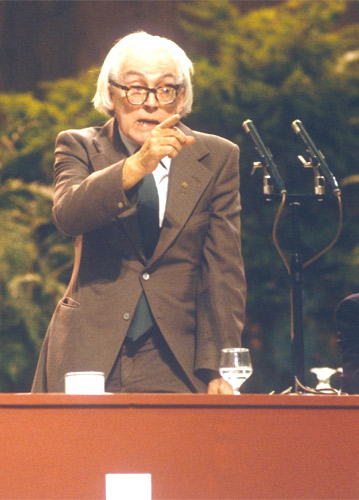
During 1943 when Michael Foot was elected for Devon port his friend Ian Mikado came to support Michael and in the process saw this very crude system of record keeping. After returning to Reading where he too was elected he developed the system and it became the party’s system nationally.The fact that it was known as the Reading pad system always irked those in Plymouth and resulted in friendly friction between the two cities. -
Community Shops
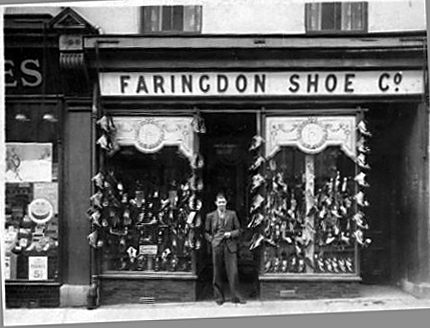
Before I go on to other areas for posterity, it may be useful to list by street the shops that we could use during the mid 1940’s. Admiralty St had no shops other than a hairdresser opposite the railway bridge to Saltash Rd. My cousin daughter Aunty Vera, Mary Monk ran this for several years. Her husband Peter always seemed to pick up draught chits in the Navy and was getting two year postings to ships away for quite a while. He was a carpenter P.O and eventually did end up at Raleigh.
Fleet St from the top, Gilbard’s corner shop opposite Mrs Tremain’s Ironmongers and she was opposite the gents barber. On the next corners were Slade’s facing a row of four shops owned and run by Co-op general grocery, butcher, greengrocer. The off license on the next corner was where my paternal Gran lived most of her time, with her sister Amy who ran the shop. They faced Northcott’s who was next door to Mrs Clark and her sister Mrs Santillo who were both widows running a very successful shop. Her son Tony Clark was probably my closest friend in growing up. At the bottom Ernie Baker, who never looked clean greengrocer next to a chip shop. On the opposite corner was a shop that was always changing in use electrical, furniture never consistent at any real range.
Victory St from the top middle corner was a general store opposite the Victory Hall which will play a big role in later pages. On the next corner William’s opposite the Post Office run by Mr and Mrs Frier and had the only phonebooth in the area. There was always someone waiting as there were very few that had phones. Opposite was Dyer’s butcher and their son Jack a year or two younger than me took it on. At the bottom left hag corner was another small general shop on the back lane. Never did go in here that I recall but I somehow remember a very large guy ran this store but he was elderly then.
Renown Street from the top on the junction with Royal Navy Avenue, there was a large general store. Behind St Thomas’s Church a small shop that had been a barbers years before but again this always seemed to change between times of being empty. Next corner Meager the butcher his son Terry was another I was with a lot but he was a good footballer. Opposite was a chip shop run by Mr and Mrs Hughes. Then at the next junction Maddocks facing Leakey’s two general stores.
Ocean St opposite the Church Mrs Rogers and opposite the school canteen Lethbridge’s whose son Michael grew up with the Keyham boys crowd. The area of Keyham was well provided for shops and most carried a fair range of goods. I would regularly be sent to Maddocks four half a stone of potatoes or a quarter of a pound of cold meat for tea.
Very few if any still survive but for those interested in what Keyham was like growing up at that time it gives a flavour of what you could get in the community. Some were farmers or smallholders who brought fresh produce every day and used the shop as their cash earning outlet in addition to the farm income, but the first years after the end of the war were tough for farmers so the shops did provide other outlets for them.
-
Marlbrough Street
In growing up at Admiralty St it was Thursdays that stick in my mind. Just like Monday, it was wash-day whatever the weather. It was a day when the copper would be boiling sheets and pillow cases that were then mangled in the back yard with a tub underneath the rollers. I graduated trolling the handle while mum organised the folding, and it was hard work. If you didn’t catch her fingers you were pretty safe, but she couldn’t half wack your ear if you did.
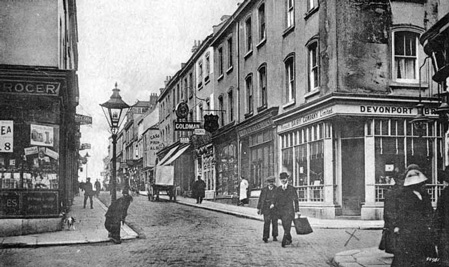
But Thursday was special because mum’s older sister Aunt Vera would come up from Wombwell Crescent where we’d all go shopping. We would catch a bus at HMS Drake to Marlborough St. On the corner was the Marlborough Hotel which was a huge pub/hotel and next door hidden away was a Chinese laundry. Each week mum would collect and drop off the current weeks collars off Dad’ shirts for starching. They attached with studs to the shirt and looked like razors. I often wondered why they didn’t cut the wearer but they all seemed safe enough.Next was Earson’s the greengrocer on the right hand side going down to Fore St. It was only the Forum and Midland Bank building stood in isolation after all the bombing. Then we went to a Mrs Goodman’s. She ran a furniture shop that was anything you want really. She was also one of the few who traded on “provi cheques”. Basically to get new furniture or lino you borrowed from the Provident who gave you a cheque for your purchases redeemable only in the named shops. You then repaid weekly at extortionate rates which was collected at your door.For many working class families with no easy access to money this was the only means of gaining anything new.
Then round the corner to Lethbridge’s was the shoe repairers for anything that helped make shoes last a little longer. Then walk back up to Fore St to catch a bus back to Drake.
This weekly trip lasted for a good number of years until we moved when I was about 10 to 67 Renown St. This was a two up two down small kitchen outside loo again no bathroom. But we did now have a gas water heater over the sink so some hot water that didn’t involve boiling a kettle or a copper saved some time.
The other two benefits were next door to Keyham Barton and our neighbours were cobblers so he did loads of work at home and did look after all our needs sometimes in an emergency. The downside was that it was right behind the convent where the school nun’s lived and also very close to the Church.But more of that later.
-
Rations
In the aftermath of the War, I suppose my mum was no different to many others. Ration books were in operation for basics like meat, sugar, milk and other commodities that have been taken for granted today. Nothing could be wasted and you could write the menus week by week as regular as clockwork. The only variations would be for the seasons, obviously more salads in the summer with vegetables being more plentiful.
On a Sunday it was a piece of beef, rarely pork and occasionally lamb. But that would have depended on what was available and at what cost. Mum did a wet roast with water gravy thickened towards the end of cooking with bisto mixed in a cup. Served with vegetables usually carrots and peas this was a one pot feast. There would then be cold meat from the leftover joint on a Monday with mash. Occasionally, if there was lots of left over vegetable, we’d have bubble and squeak. Anything left after that would be minced up to make a cottage pie on Tuesday. Wednesday would be a season pudding or steak and kidney pie and always on a Thursday train wrecking pasties, which was mother’s speciality. Friday it was fish and chips as good Catholics did on a Friday and Saturday cold meat and mash.This rarely changed and each meal had an afters of jam or lemoncurd tart homemade, suet puddings, Nelson squares or sponges with homemade custard. Sundays, we’d have a trifle which would last for Monday, bearing in mind there were no fridges. At least not in our house. There was only large granite slabs in a ladder cupboard for us. It’s quite an ask how these things were cooked and preserved so well.
The surprise was sometimes Maureen would come home with a rabbit from one of the farms the milk was collected from. Mum would skin, dissect it and cook the most amazing rabbit pies. At about the age of ten or so there was a Myxomatosis disease among rabbits and almost wiped them out, so the practice died out too. The rabbit pie is still one of my favourites, personally I think far more tasty than chicken.
I always felt sorry for my mum as she was tied to the kitchen every day. Dad worked his whole working life at Mile House bus depot as a fitter and turner and insisted on coming home for lunch Monday to Friday. He would catch a special to be through the door around 12:30, have his dinner and catch the return bus back to milehouse at 1:15. It was always tight on time, so dinner had to be on the table for when he came through the door. This however became their way of life for the 49 years that he worked there and a more light tea would follow at about 6ish.
However looking back the meals were filling, nutritious and always had mum’s mark on them and generally we weren’t hungry throughout the day. Considering the limited range of things available and the limitations on money, she did an excellent job of keeping us all healthy and full. I seem to recall dad got paid on a Thursday and would come home, pass over the money for the housekeeping they had agreed and that was it. I know many years later when mum discovered just how much dad had been earning and she wasn’t at all pleased. I think an exchange of sharp opinion happened. She was a skilled seamstress and could look at fashions and make a dress or trousers, skirts and blouses at will, but that seemed her only hobby. More likely it was the only way clothes could be obtained within their finances. I think she was more than miffed that that may have been avoidable had she known the real earnings of dad at that time. But that seemed to be the common way things were done in most swirling class households, the male attitudes dominated just about everything.
-
Keyham Barton
I’ll correct as I go along. But it’s strange how you wake and your memory throws up a name from the past. When I talked of the Earson family in Admiralty St, it was of course the name of their shop in Marlborough St. It was Cecil Moorhouse and his family who lived there and it was he who taught me the street verses. For me Admiralty St remains a big part of my education. At four years old I was taken to the gate and left in the care of Keyham Barton Catholic Primary school where I remained until I was eleven.
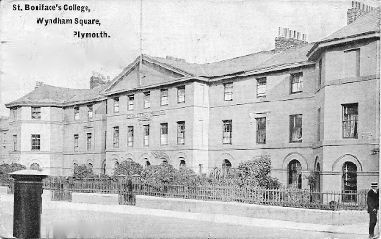
There was a real mixture of nationalities and religions in Keyham, so the Catholic community kept the role number pretty close to maximum and unless you were a Catholic you wouldn’t get it. They had an education system in Plymouth generally all of their own. St Budeaux, Holy Cross, Cathedral and later Whitleigh had the primary schools taught in Keyham by the nuns. On the same site at Keyham Barton was Holy Redeemer Secondary Modern School, run by the same order of nuns. For those who passed the 11+ there was Notre Dame for girls and St Boniface’s College for the boys. Holy Redeemer was mixed as a secondary.
This was quite the business. The education at Primary level was funded by the government. At Secondary Modern and for those who managed to pass the 11+, the cost of their education at either site was paid by the government. So there was an enormous competition between the schools to get as many passes as they could in order the be the top dog. If anyone believes that achievement tables are a new thing, they obviously were not around in my time growing up in Keyham.
The nuns were fierce and were not adverse to giving a good wacking to anyone who disobeyed them in any way. Sister Finbar ran the Holy Redeemer school, small by stature she was particularly hard in dispensing discipline. There were lots of tales from there about her prowess with a cane, they did seem to like bamboo canes. Sister Denis was the Head at Keyham Barton and she too would be harsh with discipline. After a caning she would insist you had some Ovaltine tablets. It was useless going home and saying you’d had a smacking cause the reply “what did you do wrong, you must have deserved it”. It seems in the Catholic households nun’s could do no wrong and if they disciplined you it was all part of the grand scheme of things to make you a good person.